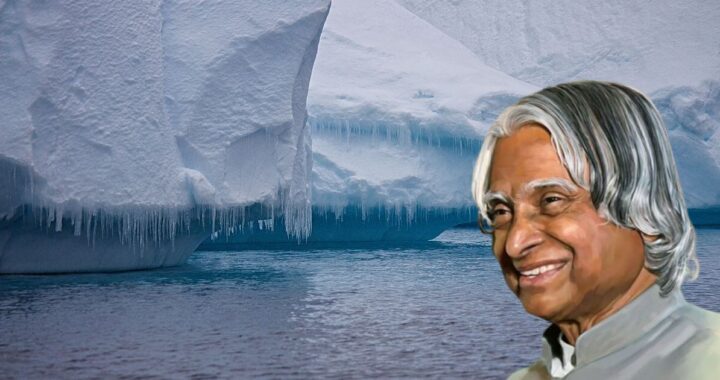
What Antarctica Taught Me About Dr. Abdul Kalam
(The following article was originally written in Marathi on 28 July 2015, the day after Dr. A.P.J. Abdul Kalam passed away. While translating it into English years later, I have retained the emotions and context of that moment.)
Sometime around 2009 or 2010, I met a cheerful gentleman who possessed a truly extraordinary experience. Listening to him gave me goosebumps, but more importantly, it revealed a side of Dr. Abdul Kalam that I had never known before.
He had been a member of an Indian research team that spent six months in Antarctica.
For most of us, Antarctica exists only on maps and in documentaries. It is a frozen continent at the southernmost point of the Earth—a place so remote and unforgiving that merely imagining a journey there can be unsettling. We often hesitate before travelling down an unfamiliar road; imagine travelling to a land where nature itself constantly reminds you of your vulnerability.
Apart from scientists and support staff conducting research during summer, no one lives there permanently. The landscape belongs largely to penguins, seals and endless stretches of ice. During summer, temperatures range from minus 2 to minus 15 degrees Celsius. In winter, they can plunge to minus 30 or even minus 60 degrees.
Scientists from around the world travel there during the Southern Hemisphere's summer, between October and March. During this period, transportation becomes possible as sea ice melts and weather conditions improve. The region also experiences continuous daylight, providing valuable time for research and exploration.
Unlike our familiar cycle of day and night, Antarctica follows a completely different rhythm. Summer brings months of uninterrupted daylight, while winter brings months of darkness. Once winter arrives, survival becomes extremely difficult. Therefore, researchers complete their work during the summer months and return before the severe winter conditions set in.
The environment itself is intimidating. Winds can reach speeds of 70 to 80 kilometres per hour. Walking becomes difficult, and in some situations people use safety ropes to move between locations. Every part of the body must be protected from the cold.
In Antarctica, exposed skin can freeze within seconds. The body begins losing heat rapidly, and survival becomes a matter of minutes rather than hours.
Even thinking about such conditions is enough to make one shiver. Yet men and women willingly travel there, dedicating themselves to scientific research in the service of their nations. Compared to such commitment, even the most extreme adventure sports seem relatively easy.
One interesting detail he shared was that the team carried nearly one and a half tons of ice cream. While this sounded surprising for one of the coldest places on Earth, ice cream provides energy and calories that help the body cope with extreme conditions. It also served as a welcome morale booster during months of isolation.
Secondly, although ice cream feels cold to the touch, its inherent nature is 'hot'; consequently, consuming it in cold weather raises the body's temperature. Yet, we tend to eat the most ice cream when the hot season begins, which ends up doing the body more harm than good.
Listening to that researcher, I realized that Antarctica is not merely a geographical location; it is a test of human endurance, discipline and teamwork. In an environment where a small mistake can have serious consequences, people learn to trust one another completely. Perhaps that is why those who return from Antarctica often speak less about the ice and more about the lessons it taught them about life.
During our conversation, he mentioned something that impressed me even more.
Before the team departed for Antarctica, Dr. APJ Abdul Kalam personally met them to review their preparations and encourage them. He did not simply sit in an office reviewing reports. He visited the scientists, interacted with them directly and ensured they were ready for the challenges ahead.
What struck me was the lasting impact that meeting had left on this man. Years after the expedition, he still spoke about Dr. Kalam with admiration and gratitude. The inspiration he had received from that brief interaction had clearly remained alive within him.
Until then, my understanding of Dr. Kalam had largely been limited to his achievements as a scientist, his contribution to India's missile programme, particularly Prithvi missile and the simplicity he displayed as President of India.
But after hearing this story, I realised that a personality like his could never be measured merely by titles or achievements.
What impressed me most was not merely Dr. Kalam's scientific accomplishments but his ability to connect with people. Whether addressing schoolchildren, guiding scientists, serving as President or personally visiting research teams, he remained remarkably approachable. He inspired people not through authority but through example. In an age where titles often create distance, Dr. Kalam used his position to bring people closer to a larger purpose—the progress of the nation.
From that day onwards, my respect for him deepened considerably.
He was a man who devoted his entire life to the growth and development of India. We are fortunate that our generation had the opportunity to witness his thoughts, his work and his example.
Today, the people mourning him do not belong to any particular region, caste or religion. The entire nation of India is grief-stricken by his passing.
He was a youthful 83-year-old who chose purpose over comfort and contribution over retirement. He remained active till his final breath, passing away while addressing students. Few people leave the world in a manner so consistent with the values they lived by.
More than a decade may pass, but people like Dr. Abdul Kalam never truly leave us. They continue to live through the ideas they shared, the dreams they ignited and the lives they inspired.
Some people are remembered for what they achieved.
Dr. Kalam will be remembered equally for what he inspired others to achieve.
Originally written in Marathi on 28 July 2015. English adaptation published in 2026.
Blog by 'Life Coach & Business Mentor' Shailesh Tandel
You may explore:
1:1 Coaching | Business Mentoring | Corporate Training | Executive Coaching | Workshops
This article is an original work and may be shared through its original link, but should not be reproduced or republished without permission.
Very well narrated…very interesting article…such a noble man APJ.was..
Thanks a lot Lathaji.
APJ indeed was a noble man, whose life continues to inspire generations.
When I heard those moments from the member of Antarctica, I was literally speechless & I wanted him to go on and on🙏