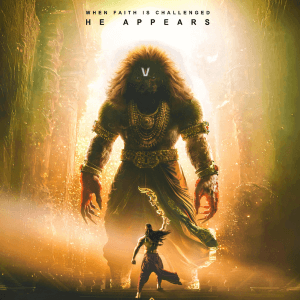
It’s rare these days to see a jam-packed theatre & people eagerly filling the front rows of a theatre before a movie begins. But that’s exactly what happened with Mahavatar Narasimha. An animated film pulling such anticipation? That in itself says a lot.
Since childhood, I’ve known the story of Bhakt Prahalad and Narasimha Avatar. Like many others, it was carved into memory, part of the many puranic stories that we grew up hearing, admiring, and retelling. So, when I heard a film was made on this story, my first thought was: What could possibly be new in it? And to add to that, an animated film? That too usually means distorted voices, exaggerated expressions, and a tone that leans more toward children’s entertainment than soulful storytelling. Especially the villain’s voice, often reduced to something resembling a street goon, as is common in many commercial Hindi animations.
But Mahavatar Narasimha completely shattered those preconceived notions.
From the first frame, the film draws you in. The pace, structure, and emotional rhythm are gripping. The story doesn't linger unnecessarily; every scene has a purpose, and the flow is seamless. What impressed me most was the clever blend of narrative and VFX. Despite being animated, the characters begin to feel deeply real and not just visually. Their expressions, their energies, and the aura of divinity or tyranny that surrounds them are strikingly vivid. The animation doesn't distract, it enhances.
It reminded me of my childhood, watching puranic films where people folded their hands the moment God appeared on the screen. There was devotion in the viewing itself. And that same feeling arose again while watching this film, not out of nostalgia, but from something deeper. Reverence.
In those puranic stories, we knew the demons would ultimately be destroyed. But as child, I missed the deeper layers, the symbolism, the reflection of those battles within our own lives. Mahavatar Narasimha does more than telling a story; it brings that ancient wisdom alive in a way that speaks directly to our times.
In the story, the demons gain power through divine boons, defeat the gods in war, and then begin to force their ideology upon everyone. Worship of Vishnu is banned. Hiranyakashyap demands that he alone be worshipped. Those who oppose are crushed. Some surrender. Some stay silent. And very few rebel. A familiar pattern, isn’t it?
And that's when something clicked.
This isn't just puranic tale. This is a mirror. Even today, in subtle and not so subtle ways, we find ourselves surrounded by systems or ideologies trying to impose their beliefs, silencing dissent, ridiculing devotion, and marginalizing indigenous cultures. If they can't convince us, they try to discredit us. Just like in the story. What was true in the Treta or Dwapar Yuga continues today under different disguises.
The biggest insight I got from the film was this: Puranic stories are not merely about what happened, rather they are about what keeps happening. They were never meant to be bedtime tales for children alone. They are guiding lights to keep us aware, awake, and aligned. They show us how history repeats itself if we forget, if we give in, if we stop believing.
It only takes one person to believe with absolute conviction. And in this story, that one person is a 5-year-old child, Prahalad. His surrender, his faith, his unshakeable love for the divine becomes the turning point not only for himself but for the world around him.
I had always heard the part where Hiranyakashyap asks Prahalad, “Is your Vishnu here?”, “Is your Vishnu there?”, “Is your Vishnu in this pillar?” And Prahalad responds, “Yes, He is.” As a child, I understood it as a poetic way of saying “God is everywhere”, in every atom, every particle. But the way this film presents that moment, it is not just philosophy. It is conviction. It is raw, courageous, living devotion.
And that is why this film is not just to be watched; it is to be experienced. Preferably in a theatre, where the impact is magnified, and the energy is shared.
So yes, I began writing this as a review, but it became something else. Mahavatar Narasimha stirred something in me that no film has in a long time. It bridged my childhood wonder with my adult insights. It showed me that even in the world of animation, spiritual cinema can rise to powerful storytelling and leave a lasting imprint.
This is not just a film for children. This is for anyone who has ever doubted the relevance of our ancient stories. It is for anyone who has ever felt alone in their beliefs. And it is especially for those who need to be reminded that change always begins with one unshakable devotee.
So, go. Watch it. Let the story unfold. And maybe, just maybe, you’ll return with more than what you expected.
Blog in Marathi - महावतार नरसिम्हा चित्रपट>>>
Blog by Life Coach & Business Mentor Shailesh Tandel
You may explore:
1:1 Coaching | Business Mentoring | Corporate Training | Executive Coaching | Workshops
This article is an original work and may be shared through its original link, but should not be reproduced or republished without permission.
Very nicely articulated. The article was not only informative but also thought-provoking—especially the part where you mentioned “They are guiding lights to keep us aware, awake, and aligned.”
Your storytelling kept me hooked from start to end.. keep going!!
Thanks a lot for taking your precious time to read this blog & writing encouraging words. Highly appreciating your gesture.
Really loved the movie… It made me cry…
But dialogue was not clear due to bgm
.. soo much of sound effect. Didnt liked it.
Okay